
Bioexcelife
In medical device and pharmaceutical compliance, safety cannot be based on guesswork.
Every chemical, residue, impurity, extractable, or leachable has the potential to create risk if exposure is not properly understood. This is where Toxicological Risk Assessment (TRA) becomes essential.
A TRA helps answer one important question:
Is this substance safe at the level patients, users, or workers may be exposed to?
It is not just a technical report. It is a science-based safety decision that supports patient protection, regulatory compliance, cleaning validation, biological evaluation, and audit readiness.
For manufacturers, a strong TRA can make the difference between a weak safety justification and a defensible compliance file.
Why Toxicological Risk Assessment Matters
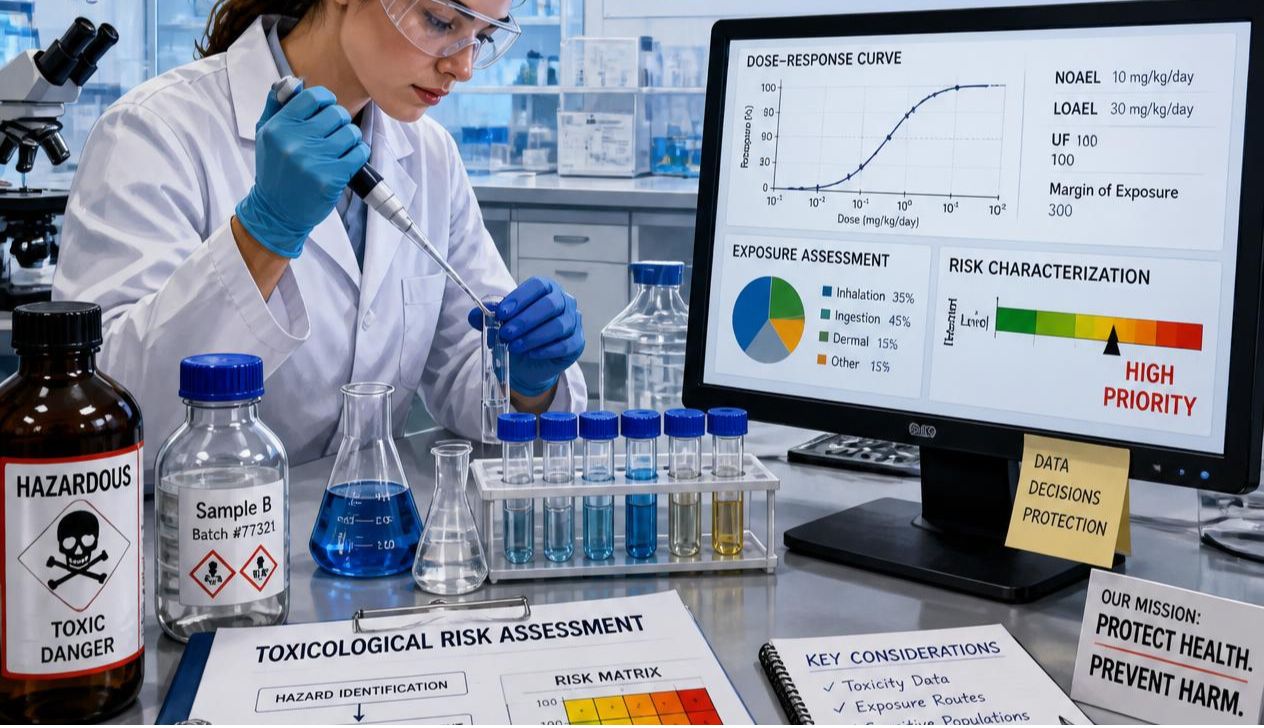
A Toxicological Risk Assessment is a structured scientific evaluation used to assess the safety of a substance based on exposure level, toxicological data, route of exposure, and intended use.
The substance may be a chemical, impurity, manufacturing residue, cleaning agent residue, extractable, leachable, or material component.
In simple terms, TRA helps determine whether exposure to that substance is acceptable or whether additional controls are needed.
Why TRA Matters
Healthcare products often involve materials and chemicals that may come into contact with patients, users, or manufacturing workers.
Even small amounts can matter if the substance is toxic, potent, sensitizing, irritating, or poorly controlled.
A TRA helps manufacturers understand the possible health impact of exposure. It also helps justify that the final product remains safe during its intended use.
This is especially important for medical devices, pharmaceutical products, combination products, sterile devices, implants, and products manufactured in shared facilities.
Where TRA Is Used
Toxicological Risk Assessment is used in several important compliance areas.
ISO 10993-17 toxicological risk assessment
For medical devices, TRA supports biological evaluation, ISO 10993 assessment, extractables and leachables review, chemical characterization, and material safety justification.
For pharmaceutical manufacturing, TRA supports cleaning validation, cross-contamination control, impurity assessment, and health-based exposure limits such as Permitted Daily Exposure.
In both industries, TRA helps convert scientific data into a clear safety conclusion.
How a TRA Works
A TRA usually starts by identifying the substance of concern.
After that, toxicology experts review available safety data. This may include human data, animal studies, dose-response information, route of exposure, exposure duration, toxicity endpoints, and known hazards.
Next, the expected exposure level is estimated. This exposure is compared with a safe limit such as Permitted Daily Exposure, Tolerable Intake, or another health-based exposure limit.
Finally, the TRA concludes whether the exposure is acceptable.
If the risk is not acceptable, the manufacturer may need stronger controls, additional testing, process changes, cleaning improvements, or further justification.
TRA and PDE: What Is the Connection?
TRA and PDE are closely linked, but they are not the same.
PDE, or Permitted Daily Exposure, is a safe daily exposure limit.
TRA is the broader scientific assessment that explains whether exposure is safe.
For example, in cleaning validation, PDE can help set safe residue limits. TRA provides the toxicological reasoning behind the safety decision.
So, PDE may be one outcome of the assessment, while TRA explains the science behind the conclusion.
TRA in Medical Device Safety
For medical devices, TRA plays a major role in biological safety.
When a device contacts the body, manufacturers must understand whether materials or released chemicals can cause harm. These risks may include irritation, sensitization, cytotoxicity, systemic toxicity, genotoxicity, or other biological concerns.
A strong TRA can help show that the identified substances are present at safe levels.
It can also reduce unnecessary testing when enough scientific evidence is available to justify safety.
Common Mistakes in TRA
One common mistake is using generic safety limits without scientific justification.
Another mistake is relying on outdated toxicology data. Some companies also ignore the actual exposure route, patient population, duration of exposure, or worst-case scenario.
In medical device files, a major gap occurs when TRA is not connected with biological evaluation and risk management.
These gaps can create audit findings, regulatory questions, and approval delays.
What Regulators and Auditors Expect
Regulators and auditors expect a TRA to be clear, logical, and scientifically justified.
They want to understand why the substance was assessed, what data was used, how exposure was calculated, and why the final conclusion is acceptable.
A strong TRA should not be vague. It should clearly connect the data, exposure estimate, safety limit, and final risk conclusion.
This makes the report easier to defend during audits and regulatory review.
Benefits of a Strong TRA
A well-prepared Toxicological Risk Assessment helps manufacturers make better safety decisions.
It supports patient safety, strengthens cleaning validation, improves biological evaluation, and supports contamination control.
It also helps companies avoid weak assumptions and build stronger scientific justification.
In simple words, TRA turns toxicology data into a clear compliance decision.
Toxicological Risk Assessment is more than a document.
It is a safety tool that helps manufacturers understand whether exposure to a substance is acceptable.
For medical device and pharmaceutical companies, a strong TRA supports safer products, stronger documentation, and better audit readiness.
When prepared properly, it gives confidence that safety decisions are based on science, not assumptions.
How Bioexcel Can Help
At Bioexcel, we support companies with Toxicological Risk Assessment, PDE calculation, extractables and leachables assessment, biological evaluation support, cleaning validation strategy, and regulatory documentation.
We help ensure your toxicological conclusions are clear, scientifically justified, and audit-ready.
Need support with Toxicological Risk Assessment? Partner with Bioexcel for safer, stronger, and more compliant product development.