

Bioexcelife
Introduction: Why Clinical Trials Have Become a Bottleneck for CE Marking
For many medical device manufacturers, CE marking under the EU MDR has become slower, costlier, and far more uncertain than under the old MDD.
One reason stands out: clinical evidence expectations have fundamentally changed.
Devices that previously relied on literature, equivalence, or post-market data are now being pushed toward prospective clinical investigations. Manufacturers who delay planning often face Notified Body objections, extended timelines, or failed conformity assessments.
This guide explains when medical device clinical trials are required under EU MDR, how they are structured, and what manufacturers must prepare to avoid regulatory dead ends.
When Are Medical Device Clinical Trials Required Under EU MDR?
Are clinical investigations mandatory for all devices?
Not always—but under EU MDR, they are required far more often than before.
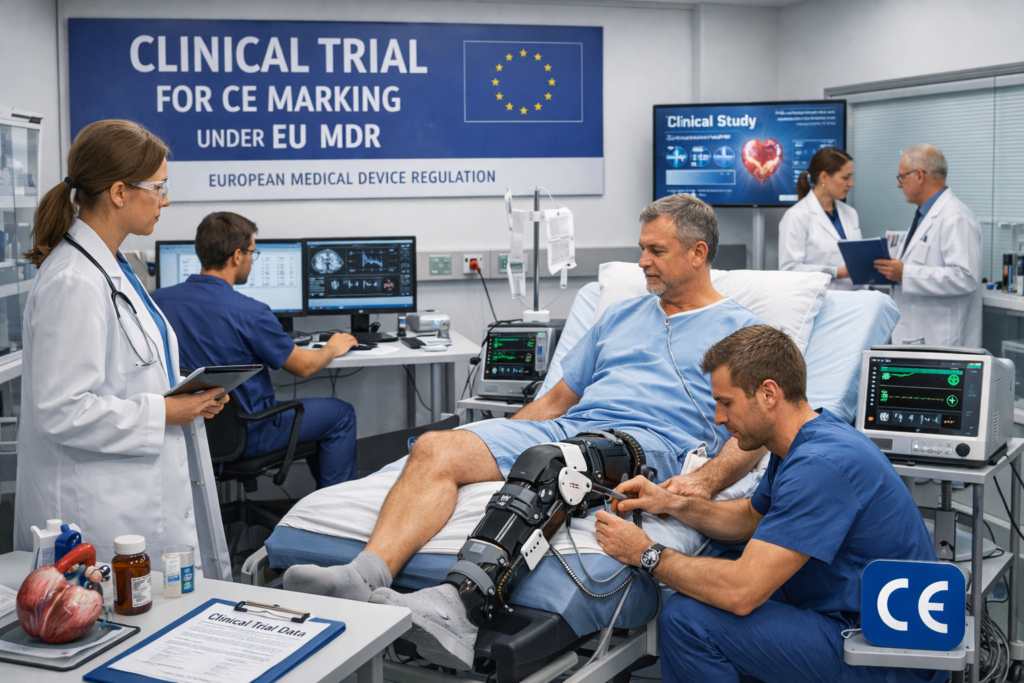
According to EU MDR 2017/745, a clinical investigation is typically required when existing clinical evidence is insufficient to demonstrate safety, performance, and clinical benefit Medical Device Clinical Trials ….
Clinical trials are expected when:
- The device is implantable or Class III
- The device is novel or uses new technology
- Clinical equivalence cannot be robustly demonstrated
- Post-market data does not adequately support claims
- Intended purpose or clinical claims go beyond existing evidence
Even Class IIa and IIb devices may require clinical investigations if gaps are identified during clinical evaluation.
Featured snippet question:
When does EU MDR require a clinical investigation?
When existing clinical evidence cannot sufficiently demonstrate safety, performance, or clinical benefit for the intended purpose.
Regulatory Framework Governing EU MDR Clinical Investigations
Medical device clinical trials in Europe are tightly regulated and must align with multiple frameworks.
Key regulations and standards
- EU MDR Annex XV – legal framework for clinical investigations
- ISO 14155:2020 – Good Clinical Practice for medical devices
- MDCG guidance documents – interpretation and expectations
- National Competent Authority requirements – country-specific approvals Medical Device Clinical Trials …
Every study must be:
- Ethically approved
- Scientifically justified
- Risk-based and proportionate to the device
Key Elements of a Compliant Medical Device Clinical Trial
A successful EU MDR clinical investigation is not just about patient enrollment. It is about regulatory defensibility.
Core components required under EU MDR
- Clinical Investigation Plan (CIP) aligned with ISO 14155
- Integration with risk management (ISO 14971)
- Clearly defined safety and performance endpoints
- Validated Case Report Forms (CRFs)
- Monitoring and data integrity controls
- Statistical Analysis Plan (SAP)
- Final Clinical Investigation Report (CIR) Medical Device Clinical Trials …
Each of these elements is scrutinized by Notified Bodies during conformity assessment.
How Clinical Trials Support CE Marking Under EU MDR
Clinical investigations are not standalone exercises. They directly feed into the clinical evaluation and technical documentation.
Clinical trial data is used to:
- Support Clinical Evaluation Reports (CERs)
- Justify intended purpose and claims
- Address residual risks and benefit-risk analysis
- Satisfy Notified Body expectations for high-risk devices
Without defensible clinical trial data, CE marking applications increasingly stall.
The Role of a Medical Device CRO in EU MDR Trials
Why manufacturers struggle alone
EU MDR clinical investigations involve regulatory strategy, operational execution, and documentation rigor—often beyond internal capabilities.
What a specialized medical device CRO provides
A CRO experienced in EU MDR supports manufacturers by:
- Designing ISO 14155-compliant protocols
- Managing investigator sites and ethics approvals
- Handling regulatory submissions to Competent Authorities
- Overseeing monitoring, data management, and reporting
- Preparing trial outputs for CE marking technical files Medical Device Clinical Trials …
Working with a CRO early reduces rework, delays, and Notified Body objections.
Common Mistakes Manufacturers Make Under EU MDR
- Assuming MDD-era clinical data is sufficient
- Delaying clinical strategy until Notified Body review
- Poor endpoint definition not aligned with claims
- Weak linkage between clinical trial results and CER conclusions
- Underestimating timelines for approvals and enrollment
Avoiding these errors can save months of delay and significant cost.
Conclusion: Clinical Trials Are Now a Strategic Requirement
Under EU MDR, medical device clinical trials are no longer optional for many products. They are a core regulatory tool to demonstrate compliance, not a last resort.
Manufacturers who plan early, design robust studies, and align trials with CE marking strategy move faster—and with fewer regulatory surprises.