
Clinical and regulatory work is becoming more connected than ever.
A protocol may change, but the data collection forms may still reflect the previous version. A reviewer may ask for evidence behind a claim, but the answer may be spread across several files. These small gaps can make clinical, regulatory, and post-market work harder to manage.
This is where VigiX360 comes in.
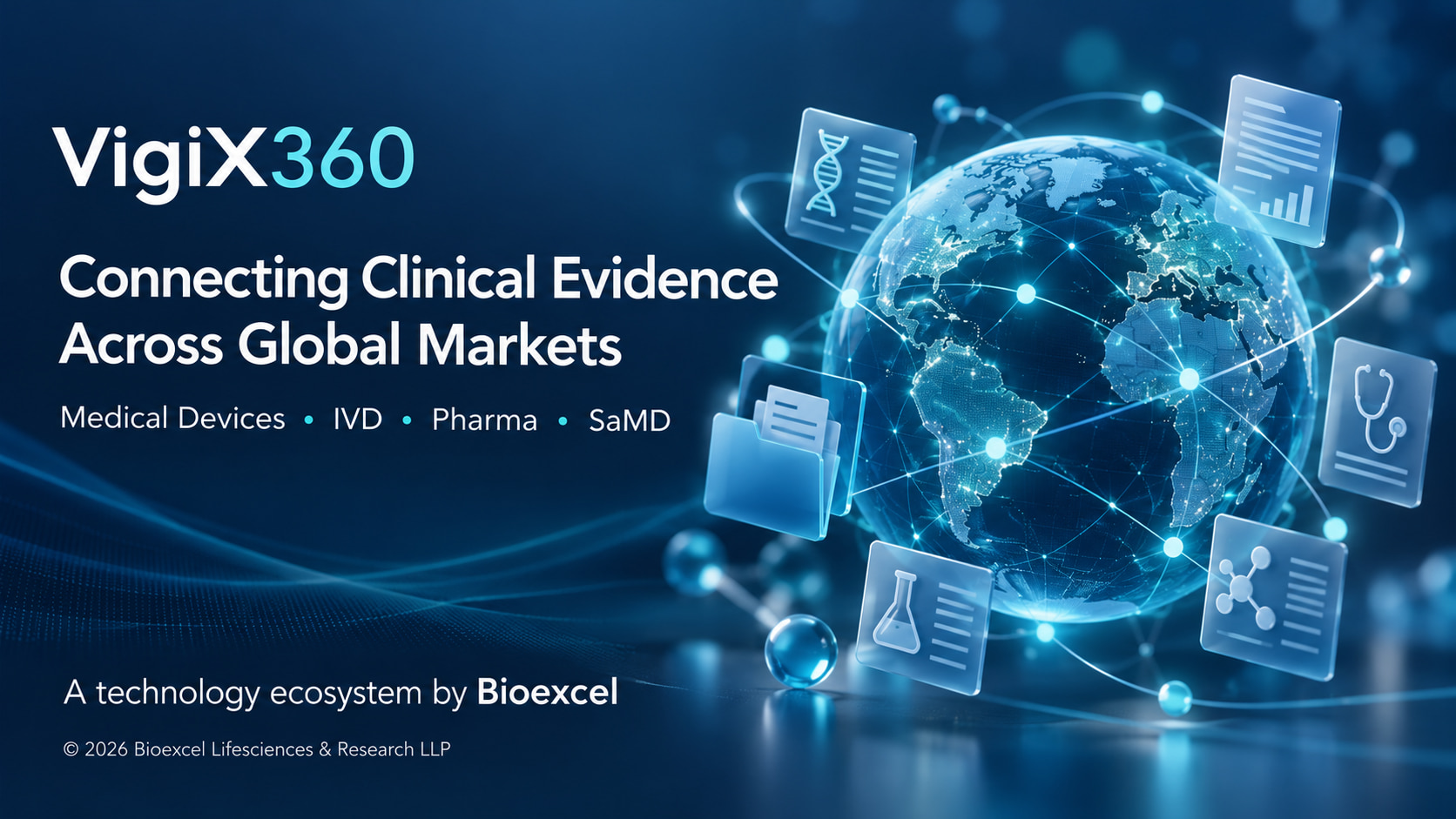
VigiX360 is Bioexcel’s proprietary technology ecosystem designed to support connected clinical evidence, study workflows, regulatory documentation, and post-market activities. Its purpose is to help teams maintain a clearer relationship between what they plan, what they collect, and what they conclude.
Why Connected Evidence Matters
Clinical evidence does not remain static.
Product claims create evidence needs. Evidence needs shape studies. Study findings support evaluation and reporting. Post-market information may reveal new questions that require further investigation.
When these activities are managed separately, teams may struggle to identify the current document, explain a decision, or track an issue from start to closure.
VigiX360 is being developed around this connected approach, with emphasis on traceability, coordinated review, and clear ownership of work.
A Public Overview of the VigiX360 Ecosystem
VigiX360 is designed as a connected ecosystem with multiple workflow areas.
Device360 focuses on product information, intended purpose, clinical claims, evidence gaps, and evidence planning.
Clinical Pro focuses on study workflows, including protocol development, electronic data capture, and clinical project coordination.
Post-market and vigilance workflows help manage the relationship between safety information, follow-up activities, and evidence updates.
This approach supports a clearer lifecycle from planning to evidence generation, review, reporting, and post-market follow-up.
From Protocol to Reviewed eCRF
An electronic case report form, or eCRF, should reflect the approved protocol.
It should capture endpoints, assessment schedules, and the information needed to answer the research question. If an eCRF collects unnecessary data, it increases study burden. If it misses an endpoint, it can affect the usefulness of the study.
VigiX360’s protocol-to-eCRF approach is intended to assist in preparing a study-specific draft for expert review. Clinical and data management teams must still verify that forms reflect the approved study, test their behaviour, and approve their release before use.
This approach is relevant for pharmaceutical trials, medical device studies, and IVD studies, with controls adapted to the specific study type.
Supporting Different Evidence Pathways
Different products need different evidence strategies.
For medical devices, the evidence pathway may include clinical evaluation, clinical investigations, and post-market clinical follow-up. The key question is whether the available evidence supports the intended purpose and claims, and how remaining gaps will be addressed.
For IVDs, performance evaluation includes scientific validity, analytical performance, and clinical performance. Performance studies and PMPF activities have distinct objectives that should be reflected in the evidence plan.
For pharmaceutical sponsors and CROs, the focus is trial-specific: approved protocol, appropriate data collection, quality oversight, and reliable records.
For SaMD and AI-enabled technologies, evidence must be appropriate to the intended purpose, target population, and product version. A connected workflow can help organise performance findings, clinical relevance, and future evidence updates.
AI Assistance With Human Review
AI-assisted workflows can help organise information and prepare material for review.
However, AI output must still be checked against source evidence, study requirements, and regulatory expectations. A generated draft is not an approved clinical conclusion.
VigiX360’s intended approach keeps qualified reviewers responsible for scientific judgement and approvals. Each AI-assisted function should be evaluated for its intended use, including how errors are detected and corrected.
This keeps accountability where it belongs: with trained clinical, regulatory, quality, and data professionals.
Relevance Across Global Markets
The need for organised and traceable evidence is shared across markets such as Europe, the United Kingdom, the United States, India, and other regions.
However, one platform configuration does not automatically satisfy every authority or every market requirement.
Implementation should consider the product category, regulatory pathway, study design, user responsibilities, privacy requirements, cross-border data arrangements, and validation evidence.
Software can support compliance, but it cannot guarantee regulatory approval by itself.
What to Discuss Before Adopting a Platform
Before adopting any clinical or regulatory platform, teams should begin with their actual workflow challenge.
A meaningful demonstration should show how the available module supports approved document versions, review responsibilities, traceability, and data export. Teams should also discuss access controls, audit trails, electronic signatures, retention, validation documentation, and confidential information handling.
These points should be verified during qualification, not assumed from a feature list.
Why VigiX360 Matters
VigiX360 is not positioned as a simple document storage system.
It is a connected digital approach intended to help teams manage the relationship between clinical evidence, study workflows, regulatory documentation, and post-market evidence.
For manufacturers, sponsors, and CROs, this connection can support better coordination, clearer review responsibilities, stronger traceability, and more accountable decision-making.
How Bioexcel Can Help
Bioexcel brings clinical and regulatory experience into the VigiX360 ecosystem.
Teams planning a clinical study, addressing evidence gaps, improving protocol-to-eCRF preparation, or coordinating post-market work can discuss their use case with Bioexcel and request a VigiX360 demonstration.
To assess fit, companies should share their product category, target markets, project stage, and main workflow challenge. Initial enquiries should remain non-confidential, with detailed requirements discussed under appropriate confidentiality arrangements.
Clinical and regulatory evidence is no longer a one-time documentation activity.
It is a connected lifecycle.
VigiX360 supports this connected approach by helping teams align study planning, data collection, clinical or performance evidence, regulatory review, and post-market updates.
For organisations working across medical devices, IVDs, pharmaceuticals, SaMD, and AI-enabled technologies, the goal is clear:
Plan better. Collect better. Review better. Conclude better.
Request a VigiX360 demonstration and discuss how Bioexcel can support your clinical evidence and global regulatory workflow needs.
Need Help With Something Like This?
Talk to our team about the clinical, regulatory or scientific evidence your program needs.
Discuss Your Requirement